
“The Iranian agenda is always regime survival,” an Iran watcher told Field. “Their strategic goal right now is to emerge from this conflict as strong as possible. Tactically, they believe that the longer the war lasts, the stronger they are, or the greater the victory. So the Iranian military aim will be to exact a price for everything the US does. They want to string the Americans out and bring them exhausted to the negotiation table.”
A former UK desk officer covering Iran nevertheless felt that time may also play in favour of the Americans. “The logic goes that by starving Iran into submission, Washington will secure a pliant Ghalibaf at the negotiating table, but perhaps also achieve the ancillary benefit of bringing down the Islamic Republic entirely.” Mohammed Bagher-Ghalibaf is the lead Iranian negotiator, speaker of the Iranian Parliament and, perhaps most importantly, a former Brigadier General in the Iranian Revolutionary Guard Corps (IRGC).
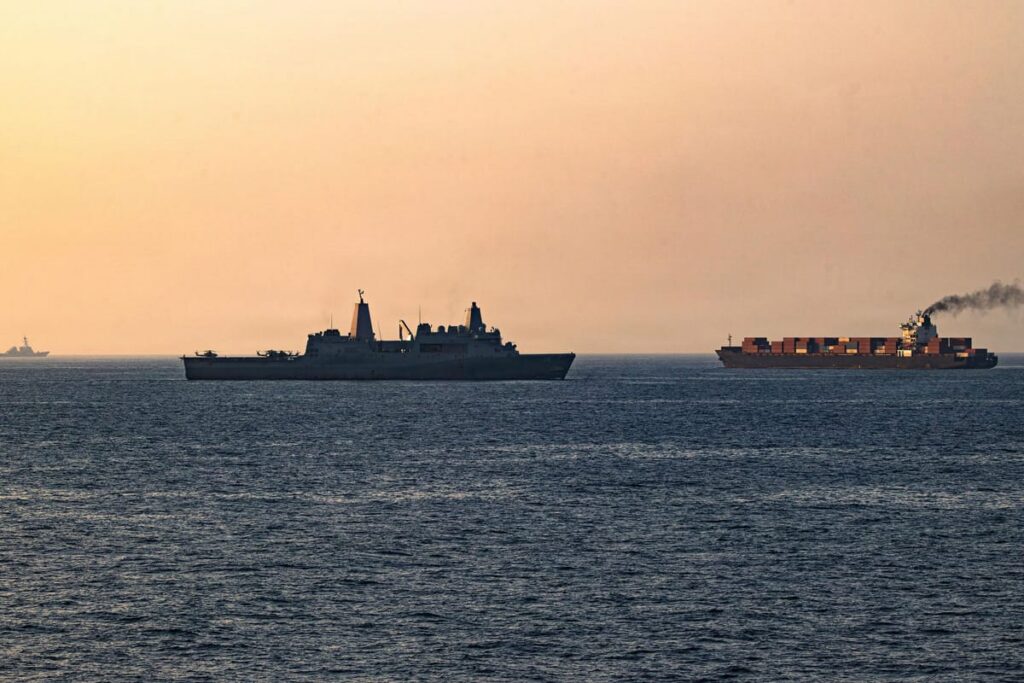
The battle for the Strait will not be straightforward, for either party. Open sources reflect the current picture. On Monday [4 May], the UK Marine Traffic Operations Centre (UKMTO) reported one carrier hit in the Strait, following two reported strikes on 3 May. Following those strike, the Iranians launched a mixed salvo at the United Arab Emirates and set fire to an oil installation in Fujairah, according to the Emirati Ministry of Defence.
“The passage of one or two carriers a day, if that, will have a negligible impact on global energy prices and on commodities,” a UK economist told Field.
A frustrated political source in the Gulf commented to Field that it was “painfully, obviously clear that the use of US military assets to allow ‘one or two’ carries through the Strait may lead to another round of very costly and fruitless fighting. And for all of this effort, however long it takes, we will end up back where we were the day before this pointless conflict happened on 27 February.”
![From “Jam-ejam” newspaper, “Hormuz Deadlock”. The text in black reads “Trump's push to reopen the Strait of Hormuz with force is met with Iran's fierce resistance”. The text in yellow says “Cotton warrior” [which has a sort of “Paper Tiger” meaning]. The black text on the bottom says “Trump's mythmaking with childish use of AI.”](https://fieldintel.co/wp-content/uploads/2026/05/image-1-250x300.png)
“Iran’s own strategic calculus is to insist on the removal of the blockade as a condition for negotiations. They believe that they have a higher pain threshold than the United States and their Western allies, who simply can’t live in a world facing oil above $120 a barrel.”
The former UK Iran desk officer told us that “Iran’s new Supreme Leader Mojtaba Khamenei may or may not be breathing unassisted. The state of his health is frankly unknown to most and pretty much reflects the state of the IRGC’s control over Iran. On the face of things it’s all ok but it could be pretty fragile. The Iranian people have been cowed into a corner by the mass murders the regime has perpetrated up until January. But what’s really stirring under the surface? How long can it hold?”
An Iranian source told Field “We are united, for the time being. But the pressure of wartime is clearly causing splits at the top of the Islamic Republic.” The source was referencing the tangible absence caused by the killing of Ali Khamenei, “the Islamic Republic lacks a ruthless leader who enjoyed respect across the political divide. Now the decade old spats between Ghalibaf and the Larijani family, between Supreme National Security Council head Mohammad Bagher Zolghadr and Mojtaba Khamenei – these really threaten to weaken the Islamic Republic from within.”
The Iran watcher added that “the emerging influence and prominence of Foreign Minister Abbas Araghchi has ruffled IRGC feathers. They are worried that the diminutive official might be making a dash for power, and they are even more concerned at the growing distance between those in favour of dialogue and those in favour of continued resistance.”
We heard some interesting commentary on the US-Iranian negotiations mediated by Pakistan. The DC insider told us that “there is a real clash of styles. The Americans went in thinking that they would impose a deal and find a grateful Iranian delegation ready to sign. I doubt they [Kushner and Witkoff] have ever met people like the Iranians before.”
The Iran watcher told us that for Tehran, “The negotiations are cathartic as well as performative, allowing them [the Iranian regime] to air long-held grievances domestically and globally, to make America sweat a bit and test their adversary’s red lines again and again, again and again. And ultimately for Tehran to wring the best possible deal, over many rounds of negotiations, as Trump and his crew simply lose interest as it becomes clear there won’t be a big pay day. Tehran will continue to ask for reparations, and push for its rights to enrich uranium commensurate with its rights as a signatory to the NPT [Non-Proliferation Treaty]. They would rather get a sellable deal in two months’ time than a bad one now.”
The Iranian source added that “Vance, Kushner and Witkoff’s certainty communicate weakness to Tehran, also their lack of technical knowledge about the nuclear file. This is all to be exploited.”
No date has been set for further negotiations. Both sides appear to wish to see how the battle for the Strait evolves. Sources in the US and externally report continued American thinking over what role ground troops might play. Where there are marine expeditionary units and airborne units there are special operations forces and this card apparently remains on the table, for unclear tactical purposes.
The Pakistanis are also reportedly already weary of what must be a thankless role as mediator. If talks do restart, the Americans will want to discuss Iran’s stockpiles of highly enriched uranium. The Iranians will ask for meaningful sanctions relief so that they can pass on something tangible to the people, and strengthen regime control.
The Iran watcher contemplated, “what if there are no further talks? The Americans will look for an off-ramp with some new crisis and quietly wind down their deployments. The Israelis will step back from further attacks on Iran and keep busy with their other projects. And the Iranians will get back to oppressing their people. There will be no ascent to liberal democracy, if anybody still thinks that’s possible. We will see endless cycles of regime infighting and public purges. And certainly no abandoning of Iran’s nuclear programme.”