
There is some cynicism as to the stated narco-war that has been established as the context for this buildup. Since 2 September US forces have killed 83 people in attacks on 21 boats purportedly carrying narcotics destined for the United States. “There’s a lot going on here, but this is not a new war on drugs,” an international journalist told us.
Drug trafficking organisations Tren de Aragua and the Cartel de los Soles have been cited as primary targets in US efforts to protect their borders from drug-smuggling. “Tren da Aragua are definitely bad news. Every narco-group has the funds for massive violence and corrupting the communities where they operate. But are they worse than any other cartel? Not to me,” the journalist told us.
The “Cartel de los Soles” is not actually a cartel but a Venezuelan figure of speech. The “soles” refer to the suns worn by generals on their military uniforms as the Venezuelan equivalent of stars. The “cartel” is a derogatory term for all corruption undertaken by elements within the military – primarily drug trafficking, illegal gold mining, money-laundering and sanctions-busting.
A Venezuela watcher described the situation in-country as “a disaster of corruption and incompetence, and the army is involved in every sector of the economy for self-enrichment.”
“Making Maduro the “boss” of the Cartel de los Soles is essentially to define the whole of Venezuela as a narco-state,” the international journalist told us. “But to what end?”.
A Western businessman in Caracas told us that, “There are many negative things about Maduro, obviously, but there is little proof linking him directly to the drug trade. The regime tolerates widespread organised crime, including drugs trafficking, but it profits through corruption rather than outright involvement. Colombian guerrillas frequently make use of Venezuelan territory as a transit country. The drugs are just an excuse, in my view.”
“The timing to oust Maduro is good,” a Venezuelan journalist told us. “He has some support in Venezuela, but everyone knows that he rigged last year’s election, and he has a lot of opponents. He is not popular in our region, no-one is going to come and save him. The Russians seem to have given up on hopeless cases, like Assad, and they don’t have surplus equipment to support Maduro. The Chinese and the Iranians aren’t going to help and he has no money to buy new friends with.”
The Venezuela watcher told us: “Maduro is in a really difficult position, frankly. The Americans can take out his navy and air force in minutes. They can also put special forces on the ground to support army units opposed to Maduro but there’s no way Trump will put boots on the ground. That would be very costly, and to achieve what?”
The Western diplomat noted that “America will have learnt from the mistakes of Iraq,” meaning that Maduro would be very likely to be allowed to leave and retire comfortably. They believed that, as with Assad, some departure of senior regime figures could be allowed to leave the country and effectively receive amnesty in exchange for not fighting to hold onto power. A bloodless coup would be a major achievement for the Trump Administration.
The Venezuelan journalist told us that “If the US attacks, a lot of Venezuelan soldiers would surrender, but Venezuela has significant armed forces, some of which could move to the jungle and put up a fight. And don’t forget, jungle means Vietnam for the Americans.”
There are different views, naturally, on what happens next. The international journalist told us that “Maduro knows his time is up. He is probably looking at real estate in Moscow or somewhere sunnier at the moment. He will also want a large amount of cash for himself. I think the Americans are amenable. I would be shocked if Maduro was still in position in a few months’ time. He only has a few weeks left.”
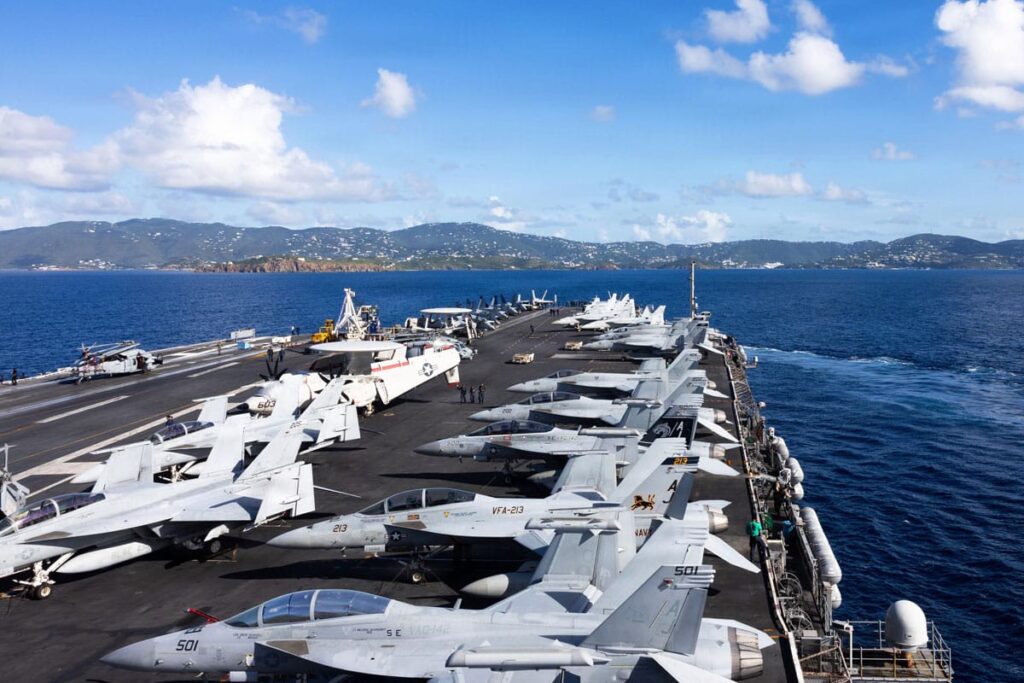
A military analyst from the region told us that the naval carrier force “would likely act” if Maduro does not leave. “If Maduro refuses to go and it [the fleet] doesn’t do anything it would be a huge loss of face for the US. So, in theory they could destroy cocaine refineries, or smuggling routes or more boats but if Maduro doesn’t go, basically, voluntarily, then the US has lost the real stand-off and blowing stuff up is the cover for a retreat.”